

Consider the operational reality inside an open-pit copper mine or an offshore drilling platform: a multi-million-dollar asset sits idle because of a sheared centrifugal pump impeller or a cracked hydraulic manifold. The replacement part costs less than a few thousand dollars, but the lead time from an overseas foundry stretches past thirty weeks. In the meantime, downtime costs accumulate at tens of thousands of dollars per shift.
For decades, heavy industrial enterprises—including mining operations, maritime fleets, steel mills, and power generation facilities—have addressed this supply risk through brute financial force. They built sprawling warehouses packed with millions of dollars in just-in-case inventory. Yet, despite massive working capital investments, maintenance teams still routinely find themselves lacking the exact component required during an emergency shutdown.
Integrating additive manufacturing into spare parts management fundamentally alters the economics of maintenance, repair, and operations (MRO). By shifting from physical storage to digital inventory and distributed on-demand fabrication, industrial operators can compress lead times from quarters to days, minimize idle working capital, and insulate their facilities from global supply chain shocks.
The Hidden Overhead of Traditional Spares Warehousing
Maintaining an exhaustive physical spare parts catalog imposes severe financial friction on an operating balance sheet. Beyond the initial purchase price, physical inventory incurs carrying costs—typically running between fifteen and twenty-five percent of an asset’s book value annually—driven by warehouse square footage, environmental controls, insurance, handling labor, and shrinkage.
Compounding this problem is the risk of obsolete dead stock. Heavy equipment lifecycles often span thirty to fifty years. As original equipment manufacturers (OEMs) modernize their machinery platforms, they routinely discontinue support or scrap casting patterns for older fleets. To guarantee future availability, plant managers often yield to foundry minimum order quantities (MOQs), purchasing ten expensive alloy components when their immediate requirement is only one. Decades later, those excess parts sit gathering dust, written off as total losses when the machine is decommissioned.
Furthermore, the global consolidation of specialized foundries and forge shops has created severe supply bottlenecks. A standard sand-casting run requires pattern making, mold preparation, pouring, cooling, heat treating, rough machining, and non-destructive testing. If a single defect appears during radiographic inspection, the entire timeline resets. An operational model tethered entirely to centralized casting networks introduces systemic fragility that heavy industry can no longer afford.
Building a Pragmatic Part-Triage Framework
The initial enthusiasm around industrial 3D printing often misleads operations teams into attempting to print every spare on the shelf. Additive manufacturing is not a wholesale replacement for high-volume conventional machining, stamping, or standard fastener procurement. Success relies on identifying the small fraction of parts that deliver the highest operational relief when digitized.
A viable integration strategy begins with a systematic inventory triage, assessing components across two primary axes: supply chain vulnerability and geometrical suitability.
High-Lead-Time, Low-Volume Components
Prioritize parts with long supplier lead times, high downtime penalties, and low annual consumption rates. Fluid-handling components such as slurry pump impellers, customized valve trim, heat exchanger heads, and specialty pipe elbows are prime candidates. These parts are rarely stocked in high quantities by local distributors, yet their unexpected failure halts continuous processing lines immediately.
Legacy and Obsolete Geometries
When an OEM no longer supplies a part, reverse engineering paired with additive manufacturing eliminates the need to retire an otherwise functional machine. Using high-resolution optical coordinate measuring machines (CMM) and industrial CT scanners, engineering teams can capture the precise internal dimensions and wear profiles of a retired part, reconstruct a parametric CAD model, and store the file in a digital warehouse for future on-demand fabrication.
Selecting Additive Technologies and Metallurgies for Severe Environments
Heavy industrial applications demand materials that withstand severe abrasion, corrosive chemical slurries, high operating temperatures, and cyclical fatigue. The additive ecosystem must match these mechanical baselines through capable metal printing technologies.
-
Wire Arc Additive Manufacturing (WAAM): Utilizing industrial robotic arms integrated with standard welding power sources, WAAM is the premier choice for large-scale structural parts, massive crane hooks, valve bodies, and vessel flanges. While the as-printed finish requires secondary CNC machining, WAAM delivers deposition rates exceeding several kilograms per hour, drastically undercutting traditional forging lead times.
-
Laser Powder Bed Fusion (LPBF): Ideal for intricate geometries with tight dimensional tolerances, LPBF processes high-performance superalloys such as Inconel 718, 316L stainless steel, and titanium alloys. It is particularly effective for internal cooling passages in turbine components, fuel nozzles, and complex hydraulic manifolds that cannot be manufactured via conventional subtractive tooling.
-
Binder Jetting: For mid-sized, high-wear components like pump sleeves or conveyor chain links, binder jetting provides rapid production speeds using metal powders, followed by furnace sintering to achieve near-full metallurgical density.
To satisfy insurance underwriters and industry regulators, printed components must match or exceed the fatigue life of their cast or forged counterparts. Post-processing is non-negotiable. Critical components frequently undergo Hot Isostatic Pressing (HIP), a thermal process that subjects the printed part to elevated temperatures and extreme isostatic gas pressure to eliminate internal micro-porosity and optimize grain structure.
Navigating Data Integrity and Technical Governance
Transitioning from physical parts to digital files shifts the operational battlefield to data security and process repeatability. A print file that yields a flawless component on a machine in Texas must perform identically when produced in an Australian mining camp.
Securing this consistency requires rigid qualification protocols. Every digital asset in the spare catalog must include an immutable manufacturing data package (MDP). This package contains not just the 3D model, but also machine-specific slicing parameters, powder feedstock specifications, recoater speeds, shielding gas flow rates, and required post-processing heat-treatment curves.
Simultaneously, industrial organizations must establish clear intellectual property frameworks. Forward-thinking OEMs are transitioning from selling physical metal to licensing validated digital design files directly to end users on a pay-per-print basis. For legacy parts where original IP has lapsed, operators must institute thorough finite element analysis (FEA) to validate that reverse-engineered geometries compensate for material property variations before field deployment.
Transitioning to a Distributed Hub-and-Spoke Ecosystem
Full integration does not require installing high-end metal powder printers at every remote site. Managing explosive fine powders and inert gas systems in harsh outdoor environments poses significant practical challenges.
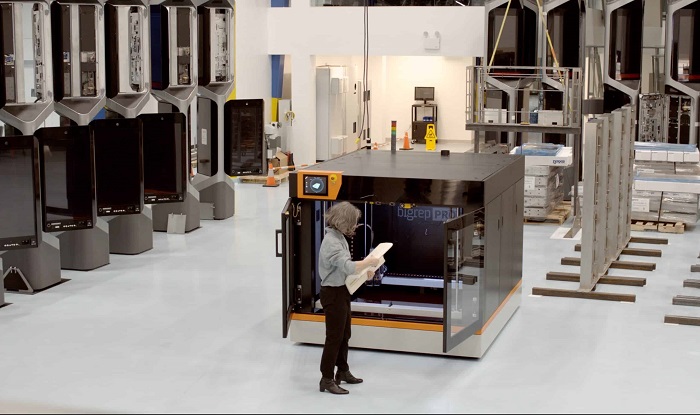
The most resilient heavy industry operators employ a hybrid layout. Point-of-need facilities maintain ruggedized polymer or continuous-fiber composite printers to produce emergency gaskets, custom fixturing, alignment tools, and low-load temporary bushings to keep machines running through a shift. Meanwhile, heavy metal component production is routed to regional additive hubs or vetted contract manufacturing bureaus strategically located near major transit corridors.
By decoupling the physical possession of spare parts from operational availability, heavy industry moves away from reactive inventory hoarding. Facilities replace millions of dollars in stagnant shelf inventory with validated CAD data, fabricating mission-critical components only when required. This operational posture protects plant uptime, eliminates supply chain vulnerabilities, and delivers an agile, responsive maintenance environment ready for unpredictable industrial disruptions.
Comments are closed.