

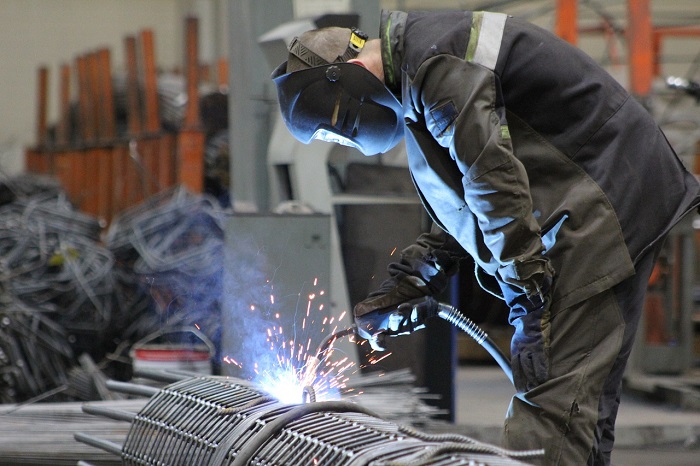
Walk through nearly any structural fabrication shop or contract manufacturing plant today, and the most common operational bottleneck looks identical. High-value custom work sits stalled on layout tables while certified journeyman welders spend half their shift running repetitive five-foot fillet welds along structural beams, skid frames, or mounting plates. These are skilled tradespeople capable of passing difficult radiographic pipe inspections, yet their working hours are tied up on routine, entry-level seams.
The demographic cliff facing the metal fabrication sector is no longer an abstract industry forecast. Experienced welders are retiring in droves, while trade schools and vocational pipelines struggle to replace them at an equivalent pace. For fabrication shops, competing for a dwindling pool of journeymen by simply driving up hourly wages is a short-term band-aid that erodes profit margins.
The shops thriving in this environment are not necessarily hiring more hands. Instead, they are systematically identifying mundane, repetitive joints and transferring them to automated welding tools. By offloading basic welding operations to accessible automation, manufacturers can multiply the productive capacity of their existing workforce without taking on the crushing overhead of traditional automotive-style robotic lines.
The Upstream Trap: Why Automation Demands Precision Fit-Up
Before evaluating welding hardware, shops must address the operational reality that causes most automated welding initiatives to stumble: upstream edge preparation. A veteran human welder possesses natural adaptive vision and manual dexterity. When a torch operator encounters a joint where the gap shifts from one-sixteenth of an inch to nearly a quarter-inch due to poor cutting or inaccurate bending, they instinctively adjust their travel speed, manipulate torch angle, or weave to bridge the void.
Automation platforms possess no such intuition. A robotic arm or mechanical carriage will blindly follow its programmed path, depositing wire at a constant rate regardless of whether a joint is tight or gapping open. If an automated torch hits an unexpected gap, the inevitable result is burn-through, incomplete fusion, or excessive spatter that requires hours of post-weld grinding.
Automating basic welds therefore requires treating the fabrication process as an integrated chain:
-
Tighter Cutting Tolerances: Transitioning from hand plasma or oxy-fuel cutting to high-definition CNC plasma, fiber laser cutting, or precision cold sawing ensures predictable joint edges with clean square faces or precise bevels.
-
Repeatable Forming Operations: Upgrading press brake tooling or establishing strict blank-size verification prevents dimensional drift across formed parts that join during final welding.
-
Standardized Modular Fixturing: Clamping parts on warped steel tables with arbitrary c-clamps introduces part-to-part variation. Utilizing precision modular welding tables with ground 28mm or 16mm hole grids and dedicated locating pins guarantees that every assembly presents its weld seams at the exact spatial coordinates expected by the machine.
Automation does not tolerate sloppy fit-up, but mastering upstream consistency pays dividends across the entire facility long before the welding torch ever strikes an arc.
Selecting the Right Equipment for Everyday Seams
Many shop owners assume that welding automation requires an intimidating, half-million-dollar enclosed robotic workcell equipped with perimeter safety interlocks and complex industrial programmable logic controllers. In reality, modern shop-floor automation spans a wide spectrum of accessible, cost-effective machinery tailored specifically for routine welds.
Mechanized Welding Carriages
For long, continuous linear welds on structural beams, tanks, stiffeners, and deck plates, simple mechanized welding carriages—often called weld tractors or buggies—deliver immediate productivity gains. These compact, track-mounted or magnetic-wheel units clamp a standard MIG or flux-cored gun and propel it along the seam at a precisely controlled travel speed. They require zero software coding, run off standard utility power, and can be deployed on a worktable or job site in minutes. An apprentice can position the track, set the carriage in motion, and walk away to prep the next assembly while the machine lays down a uniform bead.
Rotary Positioners and Lathes
When the product mix involves cylindrical workpieces—such as hydraulic cylinders, flange-to-pipe fittings, exhaust components, or threaded couplings—a rotary turntable paired with a stationary torch mount provides rapid returns. Synchronizing the rotational speed of the positioner with the power source output creates consistent circumferential welds with uniform penetration and clean puddle overlap, eliminating the stop-and-start flaws common to manual out-of-position welding.
Collaborative Robot (Cobot) Welding Cells
For complex geometric assemblies requiring multiple short welds across varied planes, collaborative robots have bridged the gap between manual work and heavy industrial robotics. Unlike traditional caged robots that require dedicated programming specialists, cobots feature lead-through programming. A welder physically guides the cobot arm to the joint, records the start and stop points via buttons on the torch head, and selects an established weld parameter schedule through an intuitive tablet interface. Cobots occupy minimal floor space, run on standard single-phase or three-phase shop power, and can be redeployed between different welding stations as daily batch priorities shift.
Turning Journeymen into High-Output Process Leads
The introduction of automation frequently triggers anxiety among experienced shop hands who fear their hard-earned craft is being devalued. Successful implementation hinges on how shop leadership frames and manages this operational transition.
The fundamental value of a seasoned welder does not lie in their ability to endure physical strain while holding a heavy torch in an awkward posture for eight hours. Their true expertise lies in their deep understanding of metallurgy, heat input, puddle control, wire feed dynamics, and shielding gas coverage. When basic welds are automated, the journeyman welder transitions into an elevated role: the welding process technician.
In this operational structure, the journeyman develops and qualifies the welding parameters—dialing in voltage, travel speed, oscillation patterns, and inductance for each joint type. Once the program is dialed in, lower-skilled operators, cross-trained assemblers, or trade apprentices can safely handle the physical loading, clamping, cycle activation, and unloading of finished weldments.
Relieving skilled welders from repetitive, ergonomically grueling seams prevents chronic physical fatigue and frees them to focus exclusively on complex custom fabrications, pipe joints, critical structural repairs, and quality validation.
Unlocking Hidden Arc-On Capacity
The true financial justification for automating basic welds extends well beyond hourly wage equations. In a typical manual welding environment, actual arc-on time—the percentage of a shift during which the welding torch is actively depositing metal—often hovers between fifteen and twenty-five percent. The remainder of the workday is consumed by joint preparation, part positioning, checking blueprints, clearing slag, and adjusting protective gear.
Even a modest automation platform routinely pushes active arc-on time past fifty to sixty percent on basic joint configurations. The machine maintains steady travel speeds without wandering off the joint, deposits wire without mid-seam pauses, and produces smooth, spatter-free beads that virtually eliminate post-weld cleanup with angle grinders.
Navigating the welder shortage does not require waiting for workforce trends to reverse. By tightening upstream cutting tolerances, choosing flexible automation tools suited to everyday geometries, and refocusing skilled tradespeople on complex metallurgy rather than repetitive seams, manufacturing operations can break their production bottlenecks and build an agile, high-margin fabrication business.
Comments are closed.