

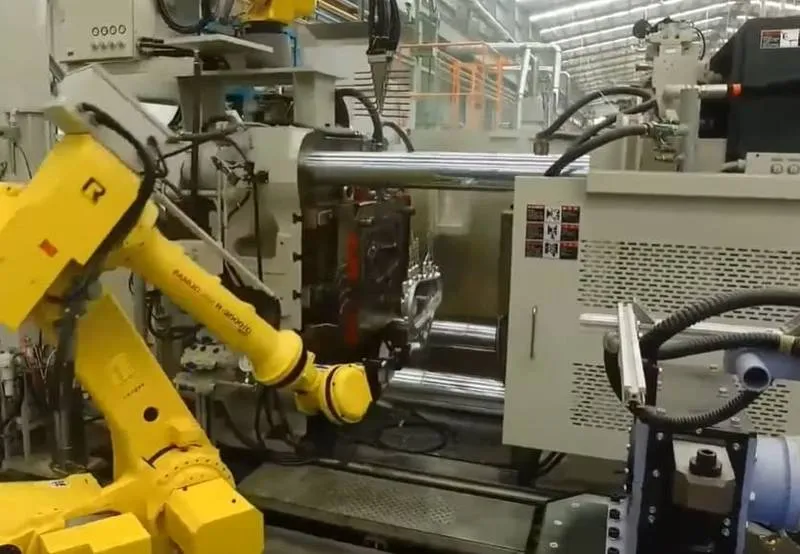
A casting that leaves your facility within tolerance can still warp years down the road. It might not show up during inspection, or even during the first year of service. Then one day a customer calls about a machined surface that no longer sits flat, a mounting hole that has drifted out of position, or a housing that leaks because the sealing face has twisted. Nobody dropped it. Nobody overloaded it. The part simply moved on its own.
This slow-motion failure mode is one of the most misunderstood issues in metalcasting, and the fix is older than most of the people reading this article. Proper heat treating aluminum castings relieves internal stresses and stabilizes the metal’s internal structure so the part stays where you put it, not just on shipping day but for the life of the component. Skip it, or cut corners on it, and you are rolling the dice on a warranty claim that might arrive a decade from now.
Here is what is actually happening inside the metal, and why the problem takes so long to show up.
Cast Aluminum Starts Out Unstable
When molten aluminum solidifies inside a mold, it does not freeze into a perfectly uniform block. Different sections cool at different rates. Thin walls solidify quickly while thick sections stay hot longer. Alloying elements like silicon, magnesium, and copper get trapped in uneven pockets rather than distributing evenly through the grain structure. The result is a casting that is internally stressed and chemically lopsided at the microscopic level, even if it looks flawless on the outside.
Those internal stresses are constantly looking for a way out. Over time, the metal slowly relaxes and shifts as the crystalline structure settles toward a more stable state. The technical term for this is natural aging, and it happens whether you want it to or not. The problem is that it happens unpredictably. A casting might drift a few thousandths of an inch over five years, or it might hold position for twenty and then move after a period of vibration, thermal cycling, or load.
For non-critical parts, this slow drift rarely matters. But for anything with tight tolerances, sealing surfaces, bearing bores, or alignment-critical features, it can be a serious problem. Some castings can take decades to fully stabilize on their own. Industry veterans sometimes cite figures as long as 50 years for certain alloys to settle naturally. That is not a quality plan. That is hope.
How Heat Treatment Stabilizes the Metal
Heat treating solves the problem by doing on purpose, and on a schedule, what nature would otherwise do randomly over decades. For heat-treatable casting alloys, the process typically involves three basic operations.
The first is solution heat treatment. The casting is heated to a temperature just below its melting point and held there long enough for the alloying elements to dissolve and spread evenly through the aluminum. Think of it as stirring sugar into hot coffee. Given enough time at temperature, the pockets of concentrated alloying elements dissolve into a uniform solid solution. This step alone removes much of the chemical nonuniformity created during solidification.
The second step is quenching. The casting is rapidly cooled, usually in water, which freezes those evenly distributed elements in place before they have a chance to segregate again. Quenching also locks in a supersaturated structure that is primed for the final step. The downside is that fast cooling introduces its own stresses, which is why quench parameters and technique matter so much. Done poorly, quenching can distort a part on the spot.
The third step is artificial aging. The casting goes back into the furnace at a relatively low temperature for an extended bake. During this hold, the alloying elements precipitate out of solution in a controlled way, forming tiny particles that lock the grain structure into its final, stable configuration. This is the step that delivers the strength gains heat treatment is known for, and it is also the step that finishes the job of stabilizing the part dimensionally.
Once the aging cycle is complete, the internal structure has essentially reached the destination it would have spent decades crawling toward on its own. The part is no longer quietly fighting itself from the inside.
The Strength Bonus
Dimensional stability is only half the story. The same precipitation process that stabilizes the casting also dramatically increases its strength and hardness. A heat-treated aluminum casting can carry loads that would permanently deform the same casting in its as-cast condition. For structural components, brackets, housings, and load-bearing equipment, this strength increase is often the primary reason for specifying heat treatment in the first place.
The stability benefit is the one people forget about, and it is arguably the more valuable one for precision applications. Strength can be tested and verified on the day the part ships. Stability can only be proven by time, and by then it is too late to fix.
Why This Matters Most After Machining
Here is where the long-term warping issue gets expensive. Many castings are machined in their as-cast or partially stabilized condition, when the internal stresses are still present but balanced. Removing metal during machining upsets that balance. The stresses redistribute, and the part moves. Sometimes it moves immediately, which the machine shop can catch. Sometimes it moves gradually over months or years of service, which nobody catches until something fails.
Shops that understand this will rough machine, stress relieve, and then finish machine. But even that practice works best when the underlying casting has been properly solution treated and aged in the first place. A casting that went through a full, correct heat treatment cycle has far less residual stress to redistribute, so it holds its machined geometry for the long haul.
This is also why heat treating should not be an afterthought tacked onto the end of a project. The decision affects alloy selection, machining strategy, tolerance stack-ups, and even fixture design. The best results come from teams that plan for it from the start.
Not All Heat Treats Are Equal
It is worth saying plainly: a heat treatment is a process, not a checkbox. Temperature windows for solution treating are tight, often within a few degrees. Too cold and the alloying elements never fully dissolve. Too hot and you risk eutectic melting, which permanently damages the part. Aging times and temperatures must match the alloy and the desired temper. Quench water temperature, transfer speed, and load configuration all influence distortion and final properties.
Different tempers also serve different purposes. A T6 treatment, which combines solution treating, quenching, and artificial aging, delivers maximum strength and hardness. Lighter treatments exist for parts that will be welded afterward, since heavy treatment before welding can lead to over-aging in the weld zone. Lower-temperature aging treatments are preferred for precision components where avoiding distortion matters more than squeezing out every last bit of strength. Overaged tempers trade a little toughness for resistance to heat and stress, which is why they show up in engine and aerospace applications.
The point is that the temper should be chosen for the application, and the process should be controlled by people who do it every day. A heat treat that is run sloppy can leave stresses behind while giving everyone false confidence that the part is stable.
The Bottom Line
Long-term warping in aluminum castings is not a mystery. It is the predictable result of internal stresses and unstable microstructure left over from the casting process, slowly relaxing over years of service. Heat treating addresses the root cause by homogenizing the alloy, relieving those stresses, and locking in a stable structure before the part ever reaches your customer.
If you are specifying cast aluminum components for anything tolerance-critical, ask early what temper the part will be supplied in and how the heat treatment will be controlled. It is a small conversation to have now compared to explaining a warped assembly ten years from now.