

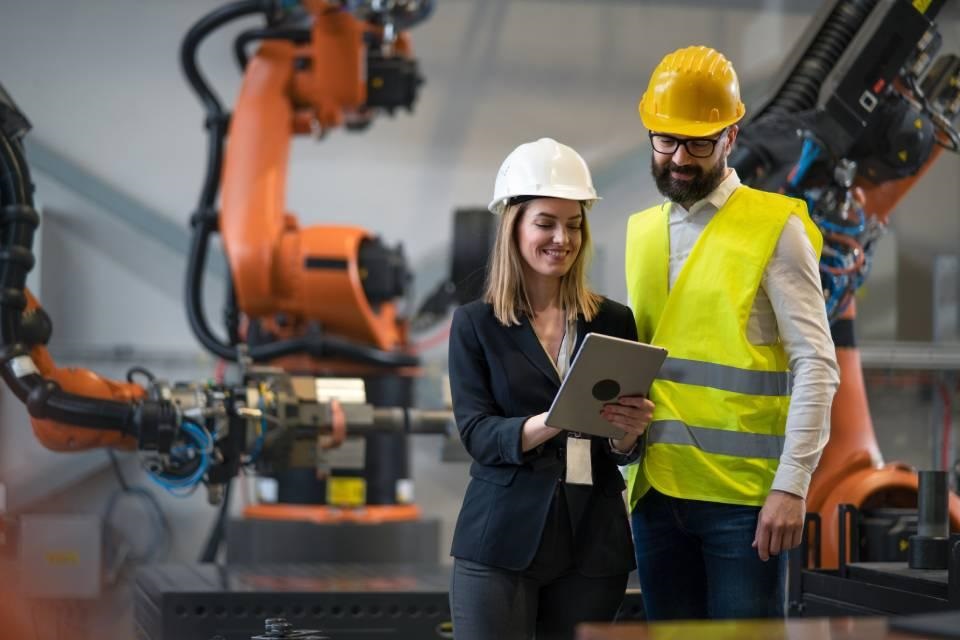
Pitching collaborative robots to a seasoned operations director or plant manager rarely goes as smoothly as automation vendors suggest. In theory, the case sounds simple: smaller footprints, plug-and-play programming, human-robot collaboration, and a rapid payback period. In practice, plant leadership has spent decades managing automation capital expenditures that ran over budget, missed delivery deadlines, and sat stranded behind yellow steel perimeter cages when product lines shifted.
To an executive whose performance bonus hinges on overall equipment effectiveness, scrap rates, and meeting rigid shipping schedules, an unproven technology is first and foremost a production liability. When manufacturing leaders push back against collaborative robots, they are not acting out of blind technological aversion. They are protecting plant throughput against disruption.
To win over skeptical leadership, engineering champions must abandon vendor-supplied sales templates and present a business case anchored in real-world factory economics, comprehensive cost modeling, and operational risk mitigation.
Moving Past the Flawed Labor Displacement Pitch
The most common mistake engineers make when seeking capital approval is presenting a balance sheet built entirely on headcount reduction. The standard calculation—multiplying an operator’s hourly base pay by forty hours a week and comparing it to the purchase price of the cobot—collapses under the slightest executive scrutiny.
Factory leadership knows that eliminating an operator is rarely that clean. An entry-level machine-tending or packaging role is rarely a single, continuous, isolated task. Operators inspect raw stock, clear chip jams, swap out bins, and notify maintenance when a spindle begins to whine. A cobot arm can execute the physical loading action, but if the surrounding responsibilities still require a human in the cell, the theoretical labor savings evaporate.
Instead of framing the technology as human replacement, anchor the operational return on investment to labor stability and turnover overhead. Across modern industrial hubs, the hardest positions to keep staffed are ergonomic nightmare assignments: deburring casting edges, stacking forty-pound cartons, or loading raw blanks into a stamping press every twelve seconds.
The financial drain on these workstations is not the base wage; it is the constant cycle of recruiting, onboarding, training, and overtime pay caused by chronic absenteeism. Demonstrating that a cobot stabilizes line throughput on high-turnover operations provides an immediate, verifiable operational dividend that plant managers recognize immediately.
Quantifying Total Deployment Economics
Skeptical executives are well aware of the hidden multiplier in traditional automation projects. With classic industrial robots, the arm itself frequently accounts for less than twenty-five percent of the total project invoice. The remaining seventy-five percent disappears into peripheral engineering fees, custom PLC programming, dedicated safety fencing, and complex mechanical interlocking.
A credible cobot proposal must present an honest accounting of the complete installation lifecycle:
-
End-of-Arm Tooling and Fixturing: Off-the-shelf vacuum grippers or pneumatic clamps rarely solve precision part-handling out of the box. Detail the machining, 3D printing, or vendor customization required for reliable part pickup.
-
Safety Validation and Risk Assessments: Collaborative does not mean inherently safe. A cobot swinging a sharp sheet metal part or hot weld torch is still an industrial hazard. Factoring in formal ISO/TS 15066 safety assessments, area scanners, or speed-and-separation monitoring prevents costly mid-deployment compliance surprises.
-
Internal Engineering Bandwidth: If in-house technicians must spend three weeks learning proprietary script logic, that represents real project cost. Quantify the simplicity of modern graphical teach pendants and lead-through programming as concrete hours saved.
By openly presenting these peripheral line items upfront, you demonstrate financial realism and dismantle the executive’s fear of hidden budget overruns.
Uncovering Secondary Financial Drivers That Move the Executive Needle
The financial impact that turns a skeptical CFO into a project sponsor almost always lies outside the direct labor line. These secondary gains stem from repeatability, utilization, and liability containment.
OEE and Spindle Uptime Optimization
On high-capital machinery like five-axis CNC mills or injection molding presses, every minute the cycle stops represents pure margin loss. When human operators manage machine tending, cycle times fluctuate wildly. Bathroom breaks, shift handovers, and material restock delays introduce micro-stoppages that erode overall equipment effectiveness.
A collaborative robot does not alter the machining time, but it standardizes the reload window. By trimming ten seconds of door-open dwell time per cycle across a three-shift operation, a machine-tending cobot can unlock enough hidden capacity to eliminate weekend overtime or defer the capital purchase of an additional multi-hundred-thousand-dollar mill.
Material Scrap and Quality Stabilization
In dispensing, adhesive application, and orbital polishing, consistency is the primary driver of profitability. Human fatigue inevitably introduces variance: inconsistent seal beads that cause field leaks, uneven torque sequences that warp castings, or over-sanded composite panels that must be scrapped.
Frame the cobot’s value through the lens of first-pass yield improvement. Cutting raw material scrap and post-assembly rework by even three percent on a high-value line can pay for a six-axis arm significantly faster than labor reallocation alone.
Workers’ Compensation and Ergonomic Liabilities
Repetitive strain injuries, carpal tunnel syndromes, and lumbar spine injuries from palletizing represent staggering direct and indirect costs for manufacturing operations. A single severe industrial back injury claim can easily eclipse the total hardware cost of a collaborative palletizing cell. Highlighting how the installation eliminates documented OSHA recordables and high-risk ergonomic tasks connects the capital investment directly to risk management and corporate liability reduction.
Structuring a De-Risked Pilot Proposal
Even with compelling financial projections, conservative leadership teams hesitate when faced with permanent floor changes. The solution is removing operational permanence from the initial approval request.
Design a phased proof of concept targeting a non-critical bottleneck. Avoid selecting the plant’s core high-speed assembly line for the maiden installation. Instead, target an end-of-line secondary packaging or off-line inspection station where a temporary failure will not starve upstream production.
Outline explicit go and no-go milestones tied to measurable operational metrics: cycle repeatability, fault-recovery time by floor operators, and weekly maintenance hours. Emphasize the modular nature of the hardware. Traditional automation cells are welded to the concrete; a pedestal-mounted cobot can be unbolted and redeployed to another cell if production volumes change or the initial application requires redesign.
When presenting the final proposal, offer financing alternatives that protect corporate cash flow. If management resists committing capital reserves to a new technology category, evaluate equipment leasing or Robotics-as-a-Service (RaaS) models. Shifting the investment from a heavy upfront CapEx commitment to a predictable operational expense often clears the final administrative hurdle, allowing the plant floor to prove the concept without enterprise-level financial exposure.
Comments are closed.