

For more than a decade, Return on Ad Spend (ROAS) has served as the north star for e-commerce performance marketing. Dashboards proudly display 400%, 600%, or even 800% returns, giving founders and media buyers the impression of runaway success. Yet behind those glowing figures, a troubling paradox frequently emerges: top-line revenue expands while free cash flow quietly evaporates.
The issue is not that paid acquisition has stopped working. Rather, the metric used to judge success was never designed to measure financial health. ROAS is a vanity metric masquerading as a profitability index. In modern Google Shopping environments dominated by automated bidding, relying on top-line revenue to guide algorithmic decisions is one of the fastest ways to scale an unprofitable enterprise.
Transitioning to Profit on Ad Spend (POAS) changes this dynamic entirely. By substituting gross profit for gross revenue, you force Google’s machine-learning algorithms to optimize for actual cash generation rather than paper turnover.
The Structural Blind Spot of ROAS
ROAS calculates a simple ratio: gross revenue generated divided by ad spend. The mathematical blind spot lies in the assumption that every dollar of top-line revenue carries identical value. In an e-commerce catalog featuring hundreds or thousands of SKUs, that assumption is fundamentally detached from reality.
Consider two hypothetical products within the same Google Shopping feed. Product A sells for $200 with an 8% gross margin, netting $16 before marketing costs. Product B sells for $60 with a 70% margin, netting $42. Under a conventional Target ROAS bidding strategy, a conversion on Product A looks exponentially more valuable to the algorithm because it delivered more revenue. If Google spends $30 to acquire the sale of Product A, the reported ROAS is 667%, appearing to be a major win. In reality, the business lost $14 on the transaction.
Conversely, if Google spends $20 to sell Product B, the ROAS sits at 300%. The algorithm may pull budget away from Product B to chase more sales of Product A, despite the fact that Product B produced $22 in net profit.
By treating all revenue equally, Smart Bidding naturally gravitates toward expensive, low-margin inventory. These items generate high conversion values with low friction, satisfying the campaign’s Target ROAS goal while quietly starving the business of working capital.
What POAS Delivers to the Bottom Line
Profit on Ad Spend shifts the equation from top-line turnover to contribution margin. The formula is straightforward:
POAS = Gross Profit / Ad Spend
Where ROAS requires an evolving, product-dependent mental calculation to determine break-even thresholds, POAS introduces absolute financial clarity.
A POAS of 1.0 represents the exact break-even point on product margins. If your POAS sits at 1.0, your gross profit matches your ad spend dollar for dollar. Every decimal point above 1.0 represents true gross cash delivered to cover operating overhead and enterprise profit. A POAS of 1.4 means that for every dollar spent on Google Shopping, you generated $1.40 in gross profit, or 40 cents of net operational surplus.
Adopting POAS eliminates guesswork for media buyers. More importantly, when gross profit data is passed directly into Google Ads, Smart Bidding stops optimizing for bloated revenue and begins hunting for margin.
Building the Data Foundation for POAS
Making the transition requires restructuring how financial data flows between your internal systems and your ad accounts. You cannot optimize for profit until you have defined it with precision.
Calculating True Contribution Margin per SKU
Many brands attempt a POAS transition by taking their sales price and subtracting the baseline manufacturer wholesale cost. This simplistic approach falls short. To build a resilient bidding model, you must calculate the true unit-level contribution margin by factoring in:
-
The landed Cost of Goods Sold (including manufacturing, freight, and customs).
-
Variable merchant gateway fees, typically around 2% to 3%.
-
Pick, pack, and standard shipping overhead.
-
Estimated allowances for category-specific return rates.
Once you establish a realistic unit profit for each SKU, you can construct a dynamic data pipeline that reflects what your business actually keeps from every order.
Choosing Your Technical Implementation Route
There are two primary methods for executing a POAS strategy inside Google Shopping, depending on your technical infrastructure:
The first method uses custom labels in your product feed. You segment your catalog into margin tiers within Merchant Center using Custom Label attributes—such as High Margin (above 50%), Medium Margin (30% to 50%), and Low Margin (under 30%). You then separate these tiers into dedicated campaigns or asset groups, assigning aggressive ROAS targets to low-margin products and relaxed ROAS targets to high-margin goods. While this approach is relatively simple to deploy, it remains a blunt instrument because it relies on static tier ranges rather than dynamic order-level profit.
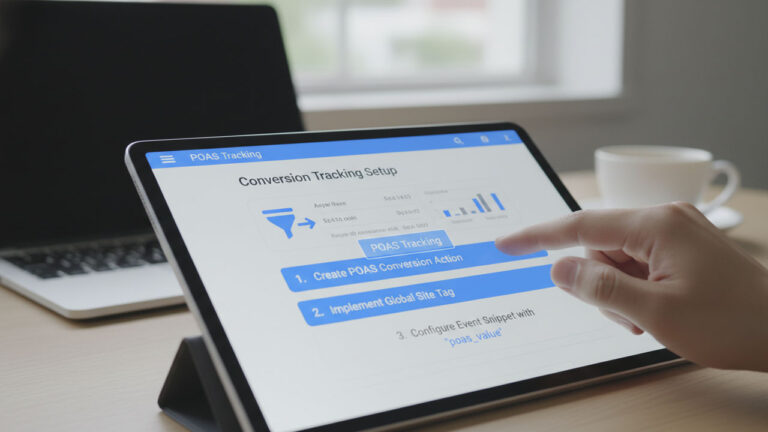
The second, superior method is server-side profit tracking. By leveraging modern feed management platforms or profit-tracking middleware, you feed the exact gross profit of an order back to Google Ads as the primary conversion value. When an order processes, your backend calculates the net margin across all cart items and transmits that profit figure via the Google Ads API or an enhanced conversion adjustment.
Under this model, the conversion value column in your ad account no longer shows $1,000 in top-line sales; it shows the $380 in actual gross margin produced.
Recalibrating Smart Bidding and Campaign Architecture
Once Google Ads receives profit data as its primary conversion value, your target bidding metrics require a complete overhaul.
Under a standard setup, you might run a Target ROAS of 400% or 500%. If you leave that target intact after switching your conversion values to gross profit, your campaigns will immediately freeze. Google will believe your conversion values collapsed overnight and slash your bids to protect the target.
Instead, your new targets must reflect your POAS targets. If your business model requires an ad-spend-to-profit ratio of 1.3 to remain healthy, your new Target ROAS inside the platform becomes 130%.
Start by setting conservative targets based on the trailing thirty days of historical margin performance. Allow the bid algorithms two to three weeks to understand the new value distribution. You will notice the system pulling impressions away from high-ticket items that produce razor-thin profits and shifting inventory priority toward mid-tier products that reliably deliver substantial margins.
The Operational Advantage of Margin-Based Bidding
Transitioning to POAS is fundamentally an operational shift rather than a creative one. It dismantles the silo between the finance department and the growth team, replacing conflicting goals with a single metric that protects cash flow.
When your media spend is tied directly to net profit, scaling decisions become objective. You no longer need to wonder whether an aggressive seasonal push actually made money or simply enriched Google at the expense of your balance sheet. By training Smart Bidding to pursue contribution margin instead of empty revenue, you transform Google Shopping from an unpredictable top-line engine into a predictable generator of sustainable bottom-line profit.
Comments are closed.